

Before buying a reading lamp, notice what is wrong with the light you already have. Is your hand casting a shadow across the page? Does a bright reflection hide the words? Is the lamp difficult to aim, or is the switch awkward to reach? A specific problem is easier to solve than a general feeling that a desk needs better equipment.
This guide offers a practical comparison process. It does not rank brands, report hands-on tests or recommend a lamp as treatment for a visual condition. If you have persistent or significant difficulty seeing, a lighting purchase should not replace appropriate professional advice.
Try moving the existing light
Place the book where you normally read and look at the page from your usual position. Move the lamp or book a little and notice whether shadows or reflections change. A useful adjustment may involve the relationship between the light, page and reader rather than a more powerful bulb.
If you write while reading, check the shadow from your hand. The convenient side for a light can differ with the task and the hand used. Try the actual writing movement rather than evaluating an untouched page on a staged desk.
Avoid improvised electrical changes or unstable arrangements. Use the lamp according to its instructions, with the correct bulb where one is replaceable. Moving a lamp to a safe, stable position is different from modifying its wiring or exceeding a specified limit.
Distinguish brightness from comfort
A brighter page is not always a more comfortable page. A bare bright source in your line of sight, a reflection from glossy paper or a sharp contrast with a dark room can be distracting. Notice the whole arrangement rather than treating one brightness number as the answer.
A shade or adjustable head can help direct the light, but the design needs to suit the book and surface. Check whether the source itself is visible from the reading position. A product photograph taken from the front may not show what the reader sees while looking down at a page.
If dimming is available, ask how it works and whether the setting is remembered. A control with many modes is useful only if you can select the one you want without repeatedly cycling through unwanted options.
Learning supply note
As an Amazon Associate I earn from qualifying purchases. A purchase through these links can support Read Iowa.
Glocusent USB rechargeable book light, blue
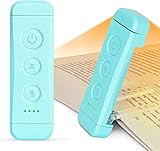
A small clip-on light with adjustable brightness, three light colors and a swiveling head. It charges through USB-A. Try the light you already have first, and check that the clip works with your book before settling in.
View this choice on Amazon USWishacc bamboo book stand, 13.2 by 9.2 inches

Five angle settings and page clips can hold a book open on a table. Check the size against your book first: the clips can be awkward with thick volumes, and the lowest angle may not suit every reader.
View this choice on Amazon USCheck reach and adjustment
Measure where the lamp can safely stand or clamp. Then consider how far the head must reach to illuminate the page. A short arm may work on a small desk but fail to reach across a wider shared table. A long arm needs a base or clamp suited to supporting it.
Look at the adjustment points. Can the head be aimed without moving the whole lamp? Does the arm stay in position? Is the adjustment comfortable to operate? Current manufacturer dimensions and instructions are better evidence than a general description such as “flexible.”
For a clamp lamp, confirm the permitted surface thickness and whether the clamp fits the edge shape. A curved or fragile surface may be unsuitable. Protect furniture according to the product's instructions rather than adding makeshift padding that prevents a secure grip.
Consider the control, not only the light
A small touch area can be convenient for one person and frustrating for another. A physical switch, dial or remote has different tradeoffs. Think about how you will operate the lamp when seated, when the room is dark and when a book occupies the table.
Check whether the control is on the base, cable or lamp head. A cable switch can become hard to reach if it falls behind the desk. A head-mounted control may require reaching over the book. These practical details can matter more than a long list of lighting modes.
If several people share the space, a simple control may make it easier to return to a familiar setting. Ask whether the lamp resumes its last setting after power is interrupted. Do not assume that behavior from the appearance of the controls.
Read the power information
Confirm whether the lamp uses mains power, a rechargeable battery or an external power adapter. Check what is included and whether the cable reaches the intended outlet safely. An advertised USB connection does not always mean the wall adapter is supplied.
For a rechargeable model, read the manufacturer's current information about charging and operation. Consider whether remembering to charge it fits your routine. A portable lamp that is frequently empty may be less convenient than a wired lamp in a regular reading place.
Use only the power arrangement specified for the product. Keep cables away from walkways and places where they can be trapped or damaged. If the intended setup requires an unsafe cable route, reconsider the placement rather than treating it as a minor inconvenience.
Think about the materials you read
Glossy magazines, matte paper, a large workbook and a screen reflect light differently. Test the lamp with the material that prompted the purchase. A setting that looks pleasant on a wooden desk may create glare on a glossy page.
If you use a book stand, try the light with the book at that angle. Tilting the page changes where reflections appear. The book-stand guide describes fit and adjustment questions, but the lamp and stand need to be considered together in the actual space.
For a shared tutoring session, make sure the light works for both positions at the table. A narrowly directed beam aimed at one reader may leave the other looking into the source or reading a shadowed page.
Compare specifications without inventing precision
Manufacturers may provide lumen output, color temperature, power consumption and dimensions. These describe different characteristics. A larger number in one field does not automatically make a lamp more suitable for the task.
Read the specifications for the exact model, including whether a stated output refers to a maximum setting. If the listing is vague or inconsistent, ask for clarification. Do not fill in missing values from a review of another product that looks similar.
This article does not prescribe a universal brightness or color temperature. The practical comparison is whether the lamp can be positioned safely, illuminate the intended material comfortably and be controlled easily in the actual setting.
A two-lamp comparison exercise
Imagine Lamp A has a compact base, a short adjustable head and one simple switch. Lamp B has a longer arm, dimming controls and a clamp. Your reading takes place at a narrow kitchen table that must be cleared each evening.
First check whether the clamp can safely fit the table. If not, B's other features may be irrelevant. If both fit, consider reach, storage and how often you move the lamp. A may be sufficient if the book sits close to it. B may be useful if the light needs to reach farther without occupying the table surface.
Now change the setting to a permanent desk with a thick edge. The comparison may change again. This exercise shows why an equipment choice should follow the place and task rather than an abstract list of desirable features.
Plan a sensible trial
Before ordering, read the return terms, delivery charge and included parts. Check whether the trial you intend is allowed under the seller's policy. Keep packaging until you have verified the fit and operation.
Try the lamp during an ordinary reading session, not only for a moment in daylight. Use the actual book, chair and table. Notice whether you keep adjusting the lamp, whether the controls are convenient and whether a reflection appears when you move the page.
Record the observations plainly. “The head cannot reach the far side of the workbook” identifies a fit problem. “The lamp feels premium” is less useful unless you can connect that impression to durability, adjustment or another feature that matters.
Avoid turning a setup into a shopping project
A reading space can remain simple. A comfortable arrangement, a useful text and a short period of attention may be enough. Buying several accessories at once makes it harder to know which change addressed the problem.
Try one adjustment at a time where practical. Move the existing light, change the page angle or test a different seat before replacing everything. If a purchase is needed, choose it for the observed limitation and keep the rest of the arrangement familiar.
The book basket collects broader selection questions. A small reading routine helps you put the setup to use, while adult-interest book selection keeps attention on the material itself. A lamp should make the page usable, then let the reading take over.
Before you choose
As an Amazon Associate I earn from qualifying purchases. A purchase through these links can support Read Iowa.
Glocusent USB rechargeable book light, blue
A small clip-on light with adjustable brightness, three light colors and a swiveling head. It charges through USB-A. Try the light you already have first, and check that the clip works with your book before settling in.
View this choice on Amazon USPut the idea to work in the practice tools, or browse the book basket checklist.