

A book stand solves a physical problem: holding a particular book at a useful angle while leaving your hands free or reducing the effort of keeping the pages open. It does not explain difficult words, change the book's language or guarantee a more comfortable posture. Begin with the problem you want it to solve, then compare the stand against the book and place where you will use it.
This is a selection guide, not a hands-on test of products. No brand is ranked here. A folded support you already own, a different table position or a library reading surface may be enough to discover which features matter before you spend money.
Measure the book, not just the stand
Choose the book you use most often and note its height, width and thickness. An open hardback, a small paperback and a large workbook behave differently. A product photograph showing a thin notebook cannot establish that a stand will support a heavy reference book.
Look at the usable back support and the ledge where the book rests. The overall width may include hinges or decorative parts that do not support the page. A shallow ledge may be awkward with a thick book, while a high front lip may cover text near the bottom of a small page.
If a listing gives only one dimension, look for a diagram or manufacturer specification before deciding. Do not guess from a lifestyle image. A seller should be able to explain what the measurement describes, and a clear return policy matters when fit remains uncertain.
Think about how pages stay open
Page holders can be clips, arms, flexible tabs or a simple ledge. Each can work in some situations and become inconvenient in others. The important question is whether you can turn a page without fighting the mechanism or covering the words you need to read.
A tight new paperback may resist staying open. A spiral notebook may lie flat with little help. A large workbook may need support near the outer edges. Compare the holder with these actual behaviors rather than treating “holds pages” as a complete specification.
Do not force a borrowed or fragile book against a mechanism that could mark or damage it. Ask the library about suitable handling if the material is delicate. The purpose of the stand is to support access, not to reshape a book by pressure.
Learning supply note
As an Amazon Associate I earn from qualifying purchases. A purchase through these links can support Read Iowa.
Wishacc bamboo book stand, 13.2 by 9.2 inches

Five angle settings and page clips can hold a book open on a table. Check the size against your book first: the clips can be awkward with thick volumes, and the lowest angle may not suit every reader.
View this choice on Amazon USGlocusent USB rechargeable book light, blue
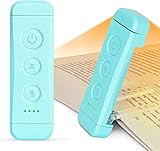
A small clip-on light with adjustable brightness, three light colors and a swiveling head. It charges through USB-A. Try the light you already have first, and check that the clip works with your book before settling in.
View this choice on Amazon USCheck the angle range and adjustment
A stand with several fixed positions can be easier to set consistently than one with a friction hinge, but the useful choice depends on the design. Read how the adjustment locks and how much effort it takes. A stand that slips under the book's weight is not serving its purpose.
Think about the surface where it will sit. A dining table, a low coffee table and a narrow desk create different viewing positions. An angle that looks attractive in a photograph may not place the page where you need it in your own setting.
If possible, try the adjustment with the book in place. Check whether changing the angle requires lifting the whole load or using two hands. For a person with limited grip or movement, the ease of adjustment may be more important than the number of positions advertised.
Look for stability in ordinary use
A book stand should remain steady when you turn a page, write a short note or touch the book. Consider the base width, contact points and surface material. A small base can be convenient for storage but may be less forgiving of a heavy book placed off center.
Do not infer stability from weight alone. A heavy stand can still be awkwardly balanced, and a lighter one can be stable with an appropriate footprint. Manufacturer limits and a practical fit check tell you more than a general claim such as “premium construction.”
Keep the stand away from the edge of a table while trying it. If it folds, check that the folding parts are secured in the working position. A product should be used according to its own instructions, including any cautions about load or placement.
Decide whether you need to write on the page
Reading and writing are different tasks. A stand that holds a novel comfortably may move when you press a pencil against a workbook. If annotation is part of the task, look for adequate support behind the area where you write and a position that does not make the wrist movement awkward.
Try a separate notebook beside the stand if that is simpler. Keeping the book upright and the writing surface flat can work well for some arrangements. It also avoids marking a borrowed book. The best setup is the one that lets you use both materials without constantly rearranging them.
For a tutor table, consider whether both people can see the page. A highly upright position aimed at one person may make shared reading difficult. A lower angle or a second copy could be more useful than a more elaborate stand.
Compare storage and carrying honestly
A folding stand can be useful if the table serves several purposes. Check its folded dimensions and whether projecting clips or hinges could catch on a bag. A device described as portable may still be too bulky for the bag you actually carry.
If you move between rooms, consider how you will carry the book and stand together. Avoid making the arrangement so complicated that you stop using it. A simple stand kept near a regular reading place may be more useful than a feature-rich model that is always packed away.
For a shared learning space, label ownership without putting private learner information on the equipment. Check whether a stand can be cleaned according to its instructions if several people handle it. Do not assume every surface tolerates the same cleaning product.
Keep product claims separate from your observations
A manufacturer may describe material, dimensions, angle positions and weight capacity. Those are specifications to confirm against the current model. Claims about better learning, relief of a condition or dramatic productivity gains require different evidence and should not be accepted because the stand looks comfortable.
Record what you can actually observe during a trial: the book remains open, the bottom line is visible, the angle stays set, and the stand fits the table. Those observations are enough to decide many practical questions without turning the trial into a health claim.
If discomfort persists or is significant, an equipment purchase is not a substitute for appropriate professional advice. This guide compares ordinary usability features and does not recommend a treatment or a posture standard for an individual.
A two-option comparison example
Imagine Stand A is compact, has a narrow ledge and three fixed angles. Stand B has a wider support, a deeper ledge and larger page arms. Your main book is a thick workbook used at a kitchen table. You also need to pack everything away after each session.
The first comparison should be fit with the workbook. If A cannot hold it securely, its smaller folded size does not solve the main problem. If both fit, compare page turning, table space and storage. B may be useful despite taking more room, or A may be entirely adequate if the book sits well.
Now change the task to reading a small paperback on a train. The priorities change. Weight, folded size and safe use in a moving space become more relevant. There is no universally best stand independent of the task.
Before ordering, check the boring details
Confirm the model, included parts, delivery cost and return period. Read whether return shipping is charged and whether the product must be unused. A low purchase price can be less attractive when a poor fit is expensive to return.
Look for current instructions from the manufacturer where available. If a seller's description conflicts with those instructions, ask for clarification before ordering. Do not rely on an old review of a similarly named model to establish the features of the item in the cart.
Keep packaging until you have checked fit within the seller's terms. Test the stand with the intended book on the intended surface. A quick trial with a thin magazine may miss the problem that matters.
Make a short keep-or-return checklist
Write five questions before the trial: Does the book fit? Can I see the full page? Can I turn pages easily? Does the angle remain steady? Can I store it where I planned? Add a sixth question if writing on the page is essential.
Answer with observations rather than a vague impression. “The left clip covers two words on each page” is a useful reason to reconsider. “It looks more professional than the old setup” may not matter to the reading task at all.
See the book basket for broader supply questions, adult-interest books for text selection, and the tutor table for planning a shared reading session. A useful stand should make that chosen task easier to carry out, without becoming the task itself.
Before you choose
As an Amazon Associate I earn from qualifying purchases. A purchase through these links can support Read Iowa.
Wishacc bamboo book stand, 13.2 by 9.2 inches
Five angle settings and page clips can hold a book open on a table. Check the size against your book first: the clips can be awkward with thick volumes, and the lowest angle may not suit every reader.
View this choice on Amazon USPut the idea to work in the practice tools, or browse the book basket checklist.