
Read Iowa reference shelf
Workplace math: a small practice workbook
Everyday number work starts before pressing a calculator key. You need to know what is being counted, which unit is being used and what answer would make sense. This newly written workbook keeps the subject of the older workplace-math address. Its examples are invented for practice, not instructions for a particular employer.
1. Count the units
Imagine six cartons, each containing eight blank notebooks. The question asks for notebooks, not cartons. Write 6 cartons × 8 notebooks per carton = 48 notebooks. Naming the units makes the multiplication easier to explain.
If a request asks for 45 notebooks, the same six cartons leave three spare. If only whole cartons can be ordered, five cartons would provide 40 and be short. The arithmetic is simple; the useful step is checking what the ordering rule allows.
Try it: nine packs contain six pens each. How many pens are there? Answer: 54. If you need 50, four remain. Explain the result in a sentence before moving on.
2. Compare unit prices
Suppose a pack of 12 costs 4.80 and a pack of 20 costs 7.00, in the same currency. Divide each cost by its count: 4.80 ÷ 12 = 0.40; 7.00 ÷ 20 = 0.35. The second pack has the lower cost per item, but the first costs less in total. Both facts can be true.
The comparison only works when you are comparing the same kind of item or a consistent measurement. A bag priced per pound and one priced per kilogram need a common unit before comparison. Do not compare the printed numbers as if their units were identical.
The unit-price tool lets you change quantities and see the arithmetic. It does not judge quality, waste, tax or delivery.
3. Read a shift as elapsed time
From 8:30 in the morning to 16:45 is eight hours and fifteen minutes. Subtract a 30-minute break in this practice example to get seven hours and forty-five minutes. In decimal hours, 45 minutes is 45 ÷ 60 = 0.75, giving 7.75 hours, not 7.45.
Try a second example: 9:10 to 14:40, less 20 minutes. The elapsed period is five hours and thirty minutes. After the subtraction, five hours and ten minutes remain. Ten minutes is one sixth of an hour, so the decimal is approximately 5.1667.
This worksheet does not determine which breaks count as paid time. Use the actual workplace policy and applicable rules for payroll questions. The elapsed-time tool is for checking the calculation only.
4. Scale a quantity
An example mixing instruction uses two measures of one ingredient for every five measures of another. A double batch needs four and ten; a half batch needs one and two and a half. The ratio stays the same when both quantities change by the same factor.
Do not apply a practice ratio to a chemical, medicine or industrial process. Actual procedures may have safety requirements, minimum quantities and rounding rules that a generic example cannot supply. Here, use colored counters or water in clearly marked practice containers.
5. Estimate before you calculate
If 19 items cost roughly three each, an answer near 60 is plausible. An answer of 570 should prompt a check for a misplaced decimal or an extra zero. Estimation is a check, not a substitute for an exact figure when one is needed.
Keep the original numbers visible. Write the operation, calculate, then attach the unit. If the result is unexpected, check the copied numbers before trying a more complicated method.
6. Keep an error notebook
Divide a page into three columns: what I tried, where it changed, and how I checked. Record a useful mistake without calling yourself careless. Mixing minutes with decimal hours is a pattern you can recognize and correct next time.
Work through the everyday numbers notes for longer examples. A tutor can use the session guidelines to choose one task at a time.
For the next practice session
As an Amazon Associate I earn from qualifying purchases. A purchase through these links can support Read Iowa.
Casio MS-80B desk calculator
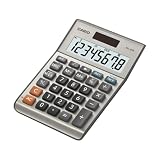
An eight-digit desktop model for checking everyday arithmetic. Keep the written method beside it, and consult the manual before using percentage or tax keys. Exam equipment rules need a separate check.
View this choice on Amazon US