

A calculator can perform the operation you enter, but it cannot know whether you entered the right quantities. Everyday number work begins with a more useful question: what am I trying to find, and in what unit? Naming the answer before calculating can prevent a surprisingly ordinary mistake, such as reporting cartons when the request asks for individual items.
The examples here are invented practice tasks. They are not payroll, safety or purchasing instructions for an employer. Use actual workplace procedures for real work, especially when a quantity affects safety, pay or a contractual obligation. The purpose of the examples is to make the reasoning visible.
Write the answer's unit first
Suppose a shelf contains seven boxes, each holding six folders. You want the number of folders. Write “folders” beside the space for the answer before multiplying. Seven boxes times six folders per box gives 42 folders. The units explain why multiplication fits the question.
Now suppose the question asks how many boxes are needed for 42 folders. The same numbers appear, but the operation changes: 42 divided by six gives seven boxes. A calculation chosen only because certain numbers look familiar can miss the actual task.
Try changing the example. Five packets contain eight labels each. How many labels are available? The answer is 40. If 36 labels are used, four remain. State both answers in sentences so that a number cannot be mistaken for a packet count.
Keep the original information visible
Copy the quantities carefully and retain the source while working. A neat calculation based on a copied number that is wrong will still produce the wrong answer. Check the copied values before repeating the calculation several times.
Use a simple layout: information, operation, result, check. For the folder example, the information is seven boxes and six folders in each. The operation is 7 × 6. The result is 42 folders. A check might be six groups of seven, or an addition such as 6 + 6 + 6 + 6 + 6 + 6 + 6.
Different checks serve different purposes. Re-entering the same expression can catch a keying mistake. Using another representation can catch a misunderstanding. Neither guarantees that the original information was correct, so retain that first check as well.
Learning supply note
As an Amazon Associate I earn from qualifying purchases. A purchase through these links can support Read Iowa.
Casio MS-80B desk calculator
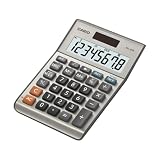
An eight-digit desktop model for checking everyday arithmetic. Keep the written method beside it, and consult the manual before using percentage or tax keys. Exam equipment rules need a separate check.
View this choice on Amazon USFive Star blue college-ruled notebook

Keep words and worked examples together in this single-subject spiral notebook. Its college-ruled lines suit compact handwriting; choose wider spacing if you need more room.
View this choice on Amazon USEstimate the size of the result
Before calculating 19 items at 3.10 each, use 20 items at roughly three to expect an answer around 60. The exact product is 58.90. An answer near 600 or six should lead you to look for a decimal or quantity error.
Estimation is not permission to round away a detail that matters. It is a reasonableness check. For a final order or payment, use the required exact figures and rounding policy. The estimate helps you recognize a result that deserves another look.
Explain your estimate aloud if you are practicing with a partner. “I used twenty instead of nineteen because it is close and easy to multiply” shows the decision. A partner can then discuss whether that approximation is close enough for the purpose of the check.
Compare costs on a common basis
Imagine two identical paper packs. Pack A has 250 sheets and costs 3.75. Pack B has 400 sheets and costs 5.20. Dividing gives 0.015 per sheet for A and 0.013 per sheet for B. B has the lower unit cost, although its total purchase cost is higher.
A lower unit price does not settle the purchase. Consider how many sheets are needed, whether the packs are actually comparable, storage, delivery and waste. The arithmetic answers a narrow question. A useful decision also needs context.
Use consistent units. If one label is per 100 sheets and the other is per sheet, convert them before comparing. The unit-price tool assumes you have already entered quantities in the same unit. It cannot discover a hidden mismatch from the numbers alone.
Watch the difference between minutes and decimals
Three hours and thirty minutes is 3.5 hours because 30 divided by 60 is 0.5. It is not 3.30 hours. In decimal notation, 0.30 hours is eighteen minutes. The two written forms can look similar while representing different durations.
For an invented shift from 8:20 to 15:50, count seven hours and thirty minutes. If the exercise asks you to subtract a 20-minute break, the remaining duration is seven hours and ten minutes. Ten divided by 60 is approximately 0.1667, so the decimal duration is approximately 7.1667 hours.
Do not infer which breaks are paid from this example. That is a separate question governed by the actual arrangement and applicable rules. The elapsed-time tool explicitly calculates duration only; it does not calculate wages or legal entitlements.
Treat percentages as a relationship
An invented inventory has 80 items, of which 20 are blue. The fraction is 20 divided by 80, or one quarter. Multiplying by 100 gives 25 percent. The percentage describes the blue items relative to the total used in that calculation.
If ten blue items are added, the blue count becomes 30 and the total becomes 90. It would be wrong to keep using 80 as the total unless the question specifically asks for a comparison with the original inventory. Thirty divided by 90 is one third, approximately 33.33 percent.
Write what the percentage is “of.” This small phrase often exposes the important choice. A percentage of the original quantity, a percentage of the new total and a percentage-point difference are different things. Do not combine them under one vague label such as “the increase.”
Round at the useful stage
Suppose a practice calculation divides 10 by three. The decimal continues. If you round each of three shares to 3.33, the shares total 9.99 rather than ten. That is not a mysterious calculator failure; the rounding has changed the values.
For an exercise, state the rounding rule and keep extra digits until the end when possible. For real money, measurement or inventory work, follow the rule required by the system or responsible person. Do not invent a rounding policy simply to make a result look tidy.
Label an approximate answer. “About 3.33” tells the reader something that a bare number does not. If whole items are required, ask whether to round up, round down or report a remainder. Ordering enough boxes and dividing a fixed stock fairly may require different treatment.
Read a table in two directions
A simple table can contain quantities for several dates or departments. Identify the row and column labels before using a value. A number can be correct in the table and wrong for your question because it belongs to another period or unit.
Practice with a small invented table in your notebook. Use rows for Monday, Tuesday and Wednesday, and columns for boxes received and boxes used. Enter 8 and 5, then 6 and 7, then 10 and 9. Total received is 24; total used is 21. The difference is three, assuming the exercise begins with no other stock changes.
State that assumption. If there was starting stock, damage or a transfer, the final stock figure would need those details too. Good number work includes noticing what information is missing rather than silently supplying it.
Make a correction useful
When an answer is wrong, record where the reasoning changed. Was the question misread, a number copied incorrectly, a unit mixed, an operation chosen badly or a key pressed twice? “I made a mistake” is true but not very helpful for the next attempt.
Use an error notebook with one short example per page. Write the original attempt, the correction and the check that caught it. Avoid copying many pages of arithmetic without identifying the pattern. The notebook should help you recognize a situation, not serve as a record of blame.
A tutor can ask the learner to explain the corrected method using a new example. Change one feature at a time. If the first example used boxes and folders, a second can use packs and labels while keeping the same operation. Then change the question to ask for the number of packs needed.
A five-question finishing check
Before accepting a result, ask: Did I answer the actual question? Did I copy the quantities correctly? Are the units consistent? Is the result a sensible size? Can I explain what the answer means in a sentence? This is an original practice checklist, not a substitute for a workplace's required verification.
Keep the checklist beside the calculator until the questions become familiar. It is especially useful when a task feels easy enough to rush. Simple arithmetic can still be attached to a misunderstood question.
For more exercises, open the workplace math workbook. The practice tools let you vary quantities and compare results. A tutor can use the session guidelines to keep the work focused on one kind of reasoning at a time.
Before you choose
As an Amazon Associate I earn from qualifying purchases. A purchase through these links can support Read Iowa.
Casio MS-80B desk calculator
An eight-digit desktop model for checking everyday arithmetic. Keep the written method beside it, and consult the manual before using percentage or tax keys. Exam equipment rules need a separate check.
View this choice on Amazon USPut the idea to work in the practice tools, or browse the book basket checklist.